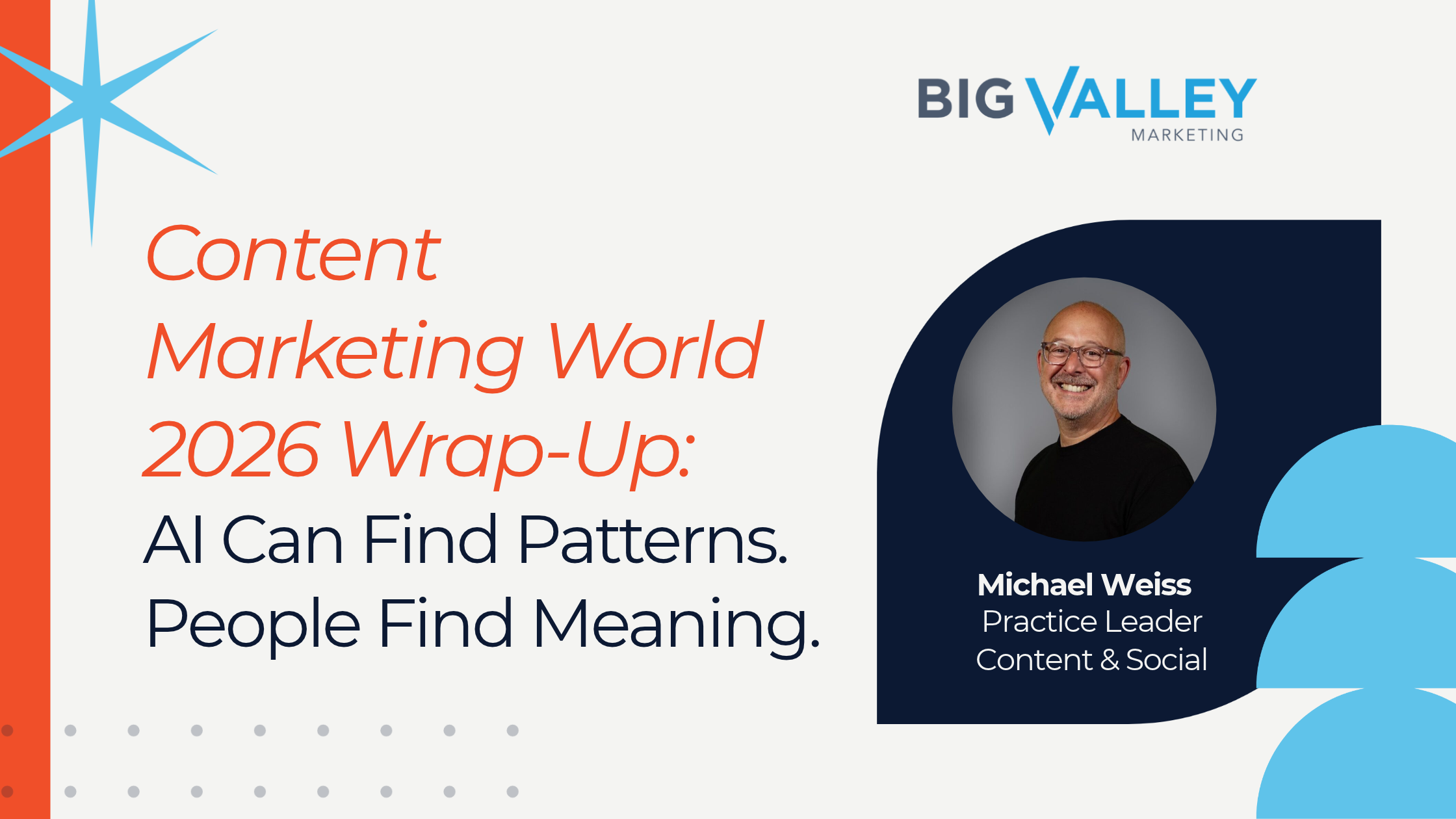
By Michael Weiss
Practice Leader, Content & Social
I came home from Content Marketing World thinking about a question that ran through my session and many conversations with my team: As AI makes it easier to gather information and produce content, where does the real value come from?
My session, “Beyond the Numbers: Turning Data Into PR and Content That Matters,” focused on using audience insights, media intelligence, social signals and performance data to find stronger stories. Data can reveal a pattern or point to a question worth pursuing. But people still have to decide what that signal means, why anyone should care and what story is worth telling.
My team heard versions of that idea across the conference.
Make content discoverable, but keep it human.
Heather Austin, our Graphic Designer, came back thinking about the website as part of discovery. AI tools may be crawling and surfacing content, but the human experience still matters. A site has to be accessible to machines and credible and useful to people. A Kuno Creative recap made a related point: marketers need to improve AI search visibility without losing the distinct voice and useful detail that make content worth finding.
More voices don’t automatically mean more impact.
Adriana Nguyen, our Director of Social Strategy, shared a lesson from Stitch’s employee content program. The company equipped close to 200 employees with the ability to create LinkedIn content. They created around 450 posts in three quarters, but it didn’t automatically mean more impact. Her takeaway was to give people support and room to contribute, while being intentional about what the program is meant to accomplish. A Markup AI recap, based on conversations with attendees and a presentation with Stitch, echoed that point: “Everyone should post” doesn’t automatically work. People need usable standards and a clear sense of what good looks like.
Joe Pulizzi’s presentation gave me another way to frame the opportunity. When content becomes abundant, brands can build a portfolio of trusted human voices instead of relying on one corporate voice or asking everyone to post. That means identifying where an audience needs trust, finding people with the expertise or experience to earn it, and giving them editorial support. Joe’s suggested roles: the expert, the storyteller and the advocate. The conference recap of his session describes a similar shift toward intentional, human-led content that gives people a reason to return.
Data reveals patterns. Experience gives them meaning.
Forest Taylor, our Director of Strategic Planning, put the craft behind this into words: The people doing this work well draw on their own experience. They know what makes a reporter pay attention, what gives a company’s story meaning and what separates a strong idea from a familiar one. As he put it, it’s the practice that makes the work worthwhile.
Lee Odden’s research adds evidence to this picture. In a TopRank Marketing and Ascend2 survey of 797 U.S. and U.K. marketing leaders, direct customer feedback influenced research topic choices for 53% of respondents, compared with 26% who cited AI or LLM-generated insights and trending queries. The report also says 32% of respondents use GenAI tools to discover thought leadership. The message I take from that: Start with people and the questions they actually have, then make the resulting perspective easy to find.
Give people something worth coming back for.
That connects directly to my session. Data helps us see something real. Human judgment helps us understand it. Story gives that meaning a form people can recognize and care about.
There’s no shortage of information or content. The opportunity is to make better sense of it, then give people something worth coming back for.